Why Is 'DA Hike' Trending? The Expected 3% Dearness Allowance Increase Explained
Central government employees and pensioners are waiting for the July 2026 dearness allowance revision, widely expected to be a 3 percentage point rise to 63%, announced before Dussehra. How DA is calculated, who gets it and when the money arrives.
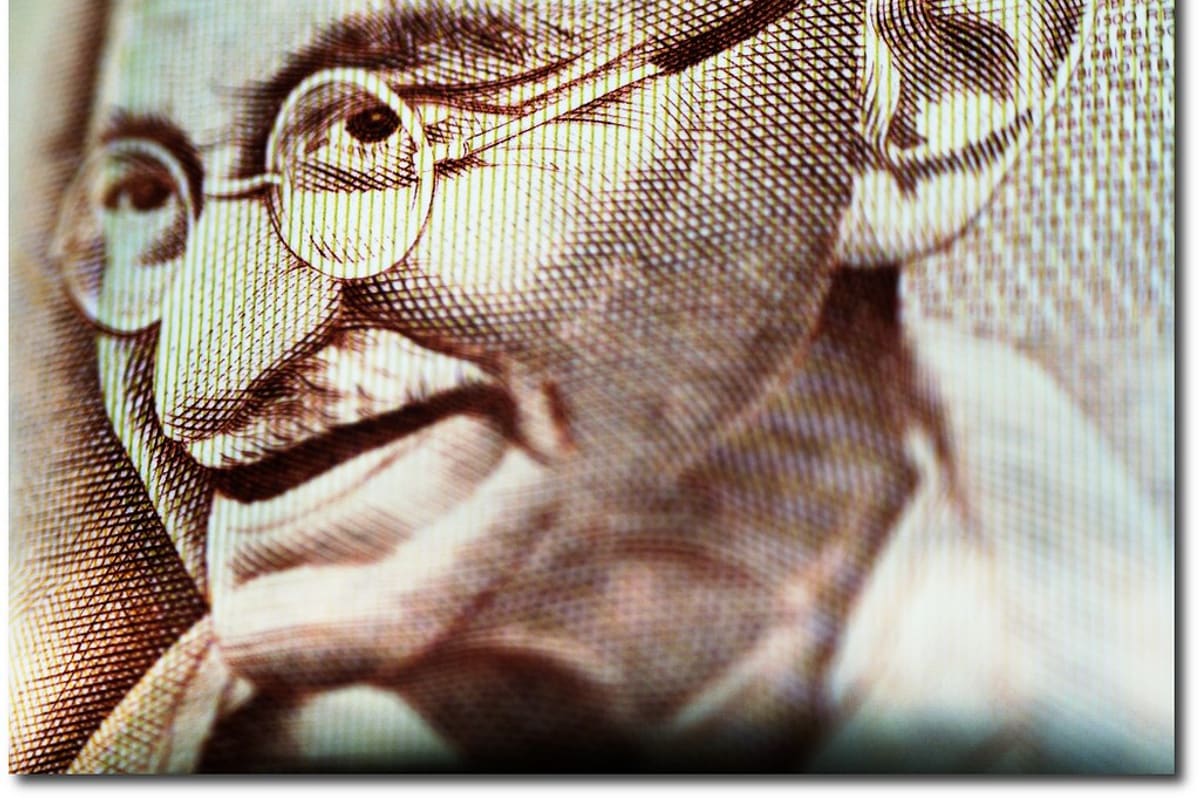
paise par mahatma. Photo: { pranav } via Flickr, CC BY 2.0.
Twice a year, "DA hike" becomes one of the most searched phrases in India, and early October is one of those times. Central government employees and pensioners are waiting for the revision due from 1 July 2026, and the expectation, based on inflation data, is a 3 percentage point increase that would take dearness allowance from 58% to 63% of basic pay. Here is what DA is, how the number is worked out and what to expect.
What dearness allowance is
Dearness allowance, or DA, is a cost-of-living adjustment paid to central government employees on top of basic pay. Pensioners receive the same percentage as dearness relief, or DR. Its purpose is to protect salaries and pensions from inflation, so it is revised twice a year: once effective 1 January and once effective 1 July.
DA is expressed as a percentage of basic pay. At 58%, an employee with a basic pay of Rs 40,000 receives Rs 23,200 a month as DA. At 63%, the same employee would receive Rs 25,200, an extra Rs 2,000 a month.
How the percentage is calculated
The figure is not decided arbitrarily. Under the 7th Pay Commission, DA is linked to the All India Consumer Price Index for Industrial Workers, published monthly by the Labour Bureau. The formula takes the twelve-month average of the index, compares it with the base, and the result is rounded down to a whole percentage.
Because the index for the months up to June 2026 is already published, analysts can calculate the July revision before the government announces it. That is why so many reports confidently say "3%": the inflation data points there. The government's role is to approve and notify it, not to pick the number.
Why it is trending right now
- The July revision is due and the data is in, so the only open question is the announcement date.
- The Cabinet has usually cleared the July DA revision in late September or October, often timed just before Dussehra or Diwali so that arrears land with festival bonuses. Dussehra is on 20 October this year.
- Employee federations, including the Confederation of Central Government Employees and Workers, have publicly asked the Finance Ministry to speed up approval.
- With the 8th Pay Commission in the news, many employees are also searching to understand how DA will be treated when a new commission's recommendations eventually apply.
Who benefits
The central DA order covers central government employees and central pensioners, together more than 1.1 crore people. Most state governments follow with their own orders in the weeks after, sometimes at the same rate and sometimes with a lag. Public sector banks, PSUs and autonomous bodies have their own DA arrangements and are not covered by the central order.
When the money arrives
Once the Cabinet approves the revision, the Department of Expenditure issues an office memorandum. Salaries for the following month reflect the new rate, and arrears for the months since 1 July are paid in one go, usually in the same or the next salary cycle. For pensioners, the DR arrears follow the same pattern through the pension-disbursing bank.
What a 3-point rise means in rupees
- Basic pay Rs 25,000: DA rises from Rs 14,500 to Rs 15,750, an extra Rs 1,250 a month.
- Basic pay Rs 40,000: from Rs 23,200 to Rs 25,200, an extra Rs 2,000.
- Basic pay Rs 60,000: from Rs 34,800 to Rs 37,800, an extra Rs 3,000.
- Arrears for July, August and September would be three times the monthly increase.
These are illustrations based on the expected 63% rate; the actual rate is whatever the Cabinet notifies.
Frequently asked questions
Has the DA hike for July 2026 been announced?
Not at the time of writing. The expectation of 3 percentage points comes from the published inflation index, not from a government statement.
What is the current DA rate?
58% of basic pay for central government employees, with dearness relief at the same rate for pensioners.
Will DA arrears be paid?
Yes. Whenever the July revision is notified, arrears from 1 July are paid along with a subsequent salary or pension.
Does the DA hike apply to state government employees?
Not automatically. Each state issues its own DA order, though most broadly follow the central rate.
Will DA be merged into basic pay when it crosses 50%?
There is no automatic merger under the 7th Pay Commission. DA crossed 50% in 2024 and continued to be paid separately. How DA is handled in future is a matter for the 8th Pay Commission's recommendations.